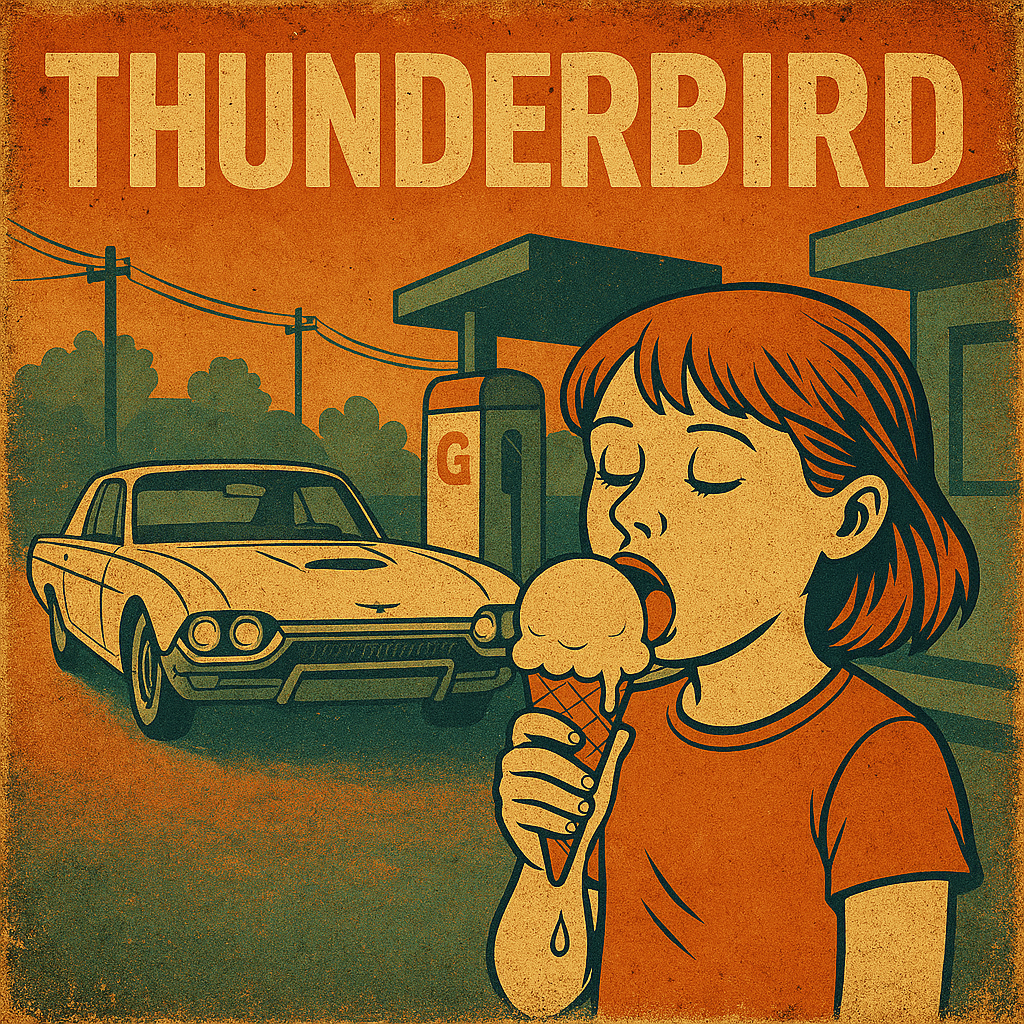
 The summer evening unfurled, stretching its last rays across the glinting rooftops and the winding road ahead. Our mighty chariot, a ’62 Ford Thunderbird, rolled south towards the drive-in theater, its engine humming with adventure. My father had restored the beast himself—its frame held together by sweat and resolve.
We pulled into a gas station at the corner. Here, men still performed their rites—lifting hoods, wiping windshields, offering to check the oil with a quiet reverence for the machines they served. My father nodded in approval. There was something ancient in the ritual, something that tethered men to the world, a transaction that required no words beyond the grease-stained handshake of mutual understanding.
Mom took Kel into the corner store. She came back, proud as a queen, with a chocolate-dipped cone already melting across her fingers. The smell of gasoline lingered in the warm air, and I breathed it in like it was perfume. I’ve always loved that smell—even now.
We climbed back into the Thunderbird, the seats still warm from the sun. Kel sat beside me in the back seat, four years old, swinging her legs and holding the cone like a trophy. She licked her fingers and hummed softly, lost in her magic little world. Dad gave the ignition a twist, revved the engine twice—just to feel it—and we rolled out on to the boulevard with the windows down, the evening air in our hair.
The drive-in was near. I imagined the giant screen already glowing, cartoons dancing in slow loops before the movie began. I wondered why everyone always honked when the hotdog finally slid into the bun.
A flick of the wheel. A turn back onto the boulevard. The early evening sprawled ahead of us—restless, waiting.
And then they appeared.
Satan’s Angels. Two of them draped in leather, patches stitched across the back—white letters curling above a red devil with a pitchfork. You didn’t need to be an adult to know who they were. Even I knew. We heard them before we saw them. The two motorcycles came up behind us fast, engines snarling, chrome flashing in the twilight. They weaved recklessly between lanes before cutting us off hard—forcing my father to hit the brakes and steer towards the curb.
The Thunderbird jolted. Kel’s cone slipped from her hand and exploded against the back of the seat. She sat for a moment in stunned silence, then started to cry, sticky hands frozen mid-air.
The bikers zoomed off, continuing to slip between traffic up and down the boulevard.
My father’s hands tightened on the wheel. My mother inhaled sharply, already sensing the shift.
“Paddy, don’t start anything.”
But it had already begun. The fire in my father’s eyes had been kindled.
The Thunderbird dropped a gear and growled to life, surging forward like it had been waiting for the call.
Just ahead, a break in traffic opened like a door—wide enough for him to move without weaving. My father took it. Clean. Decisive.
We picked up speed—fast, but not frantic. The wind rose around us, and the tires gripped the road with purpose. I grabbed the seat in front of me, heart thumping as we closed the gap. No one used seatbelts back then. The bikers darted left and right, slipping between cars like snakes, but my father stayed locked in—eyes forward, hands steady, threading the Thunderbird through the boulevard like he was born to it.
He spotted another opening and took it, swerving across two lanes with surgical control. The Thunderbird slid in beside them, pinning them toward the shoulder. Brakes squealed, horns blared. One of the bikes wobbled as the younger one oversteered, nearly clipping a mailbox. They had no choice. They pulled over.
The door of the Thunderbird opened, and my father stepped into the twilight. The street lamps crowned him in their glow as he walked with quiet purpose toward the bikers. The younger man dismounted, his stance full of insolence and swagger, his words a string of coarse insults that slithered through the air. My father said nothing. I watched him, sensing something beyond anger in his silence.
Then, without flourish or hesitation, my father struck.
His left fist met the biker’s mouth with a thunderous crack. A gasp of air, the shocking crunch of bone and ivory—then silence. The biker staggered backward, clutching his face as blood dripped between his fingers. One by one, his teeth rained to the ground, tiny white relics scattered upon the pavement. His companion, a silent witness to this swift reckoning, remained on his bike shaking his head.
Then—lights of red and blue split the dusk. An RCMP cruiser rolled to a stop, and the officer stepped out, the radio murmuring behind him.
The biker stammered through his ruined mouth, gesturing wildly, his voice laced with agony and outrage. “He fuckin’ knocked my teeth out!”
My father was unshaken, resolute.
The constable’s judgment was swift. “Go see your lawyer about that,” he muttered to the broken warrior, before turning his gaze to my father. “You, go home.”
No shackles, no trials—only an understanding, unspoken yet immutable. The world had its own justice, and tonight, it had been served.
Returning to the Thunderbird, my father flexed his hand. The rogue’s rotting teeth had left their mark, but soon he was in my mother’s care, his wounds bound while Kel slumbered on the couch beside them.
That night, as the world tilted and the moon cast its silver judgment upon us, I lay awake, considering the spectacle I had witnessed. My father had moved like a hero, reckless yet righteous, swift yet deliberate, a man balanced upon the blade of justice and fury.
And I—eight years old, but no longer as young as I had been—stared at the ceiling of our home, waiting for sleep that would not come.