add_filter( 'auto_update_plugin', '__return_true' );

The Loudest Generation

We were the loudest generation.
Not because we had the most to say—
but because we had no idea who was listening.

Our gods didn’t sing in tune.
They screamed through amplifiers and shredded leads like their lives depended on it—because sometimes, they did.

We were raised by riffs.
Our gospel was printed on liner notes and buried in distortion.
We bought albums for the art, and waited all day to tape a single off the radio.

This is a book about the wall of sound that shook our bedrooms, rattled our parents, and gave us a voice before we even had one.

Hard rock. Heavy riffs. Grunge and glam and thrash and everything in between—

The Loudest Generation is a love letter to the guitar—to the records that saved us, the bands that shook us, and the solos that still lift us when nothing else can.

Chapter 1: Raised on Riffs

We were raised on riffs. When our bands hit the stage, they didn’t just play — they shook the place to its bones. Metallica turned speed and fury into scripture. Guns n’ Roses swaggered like they had gasoline in their veins. AC/DC hammered out riffs so primal they felt carved in stone.  This was the era when the guitar solo ruled, when amps howled like jet engines, and when the stage became a place of baptism.

These bands gave us what we craved: authenticity and intensity. Metallica’s thrash was all edge and discipline, like a blade sharpened on concrete. Each chorus was an anthem, each riff a dare. They weren’t just writing songs — they were building weapons for kids who didn’t know how else to fight.

And when the ground shifted, from the cracks came a new sound. Nirvana, Pearl Jam, Soundgarden — music that wasn’t polished, wasn’t pretty, but felt like it was carved straight from the stomach. It wasn’t about solos anymore; it was about raw emotion, shouted until your throat bled.

Before the internet, you didn’t scroll — you gathered. Around the radio, around MTV, around the stereo where a record spun from first track to last. We were the last ones to share music this way. Albums were pilgrimages. Singles were trophies caught on cassette tape after waiting all night by the speakers.

Our music endures because it wasn’t just entertainment. It was confession, rebellion, ritual. It captured the anxiety of standing with one foot in the analog past and the other in a digital future. It was the soundtrack of a generation that didn’t trust perfection — and didn’t want it.

But let’s not pretend we were born in a vacuum.
Before the thrift stores and broken homes, there was already a mansion of sound waiting for us—
built by the blues, gospel, and country of the American South.

Robert Johnson at the crossroads.
Mahalia Jackson shaking the rafters.
Hank’s ghost flickering in the neon glow.
These weren’t songs for radios. They were survival.

The first detonation.
Chuck Berry’s grin and strut.
Little Richard’s howl that could level a church.
Elvis’s hips moving like blasphemy.
Rock ’n’ roll was born messy, hungry, and loud.

And then — silence. February 1959.
A small plane fell out of the Iowa sky and took Buddy Holly, Ritchie Valens, and The Big Bopper with it.
The Day the Music Died.
Rock had its first heartbreak.

In the echoes of that silence, seeds began to grow.
Some sprouted in daylight, like the Beatles, dazzling the world with joy.

But others grew in the shadows.


Chapter 2: Before Distortion Had a Name

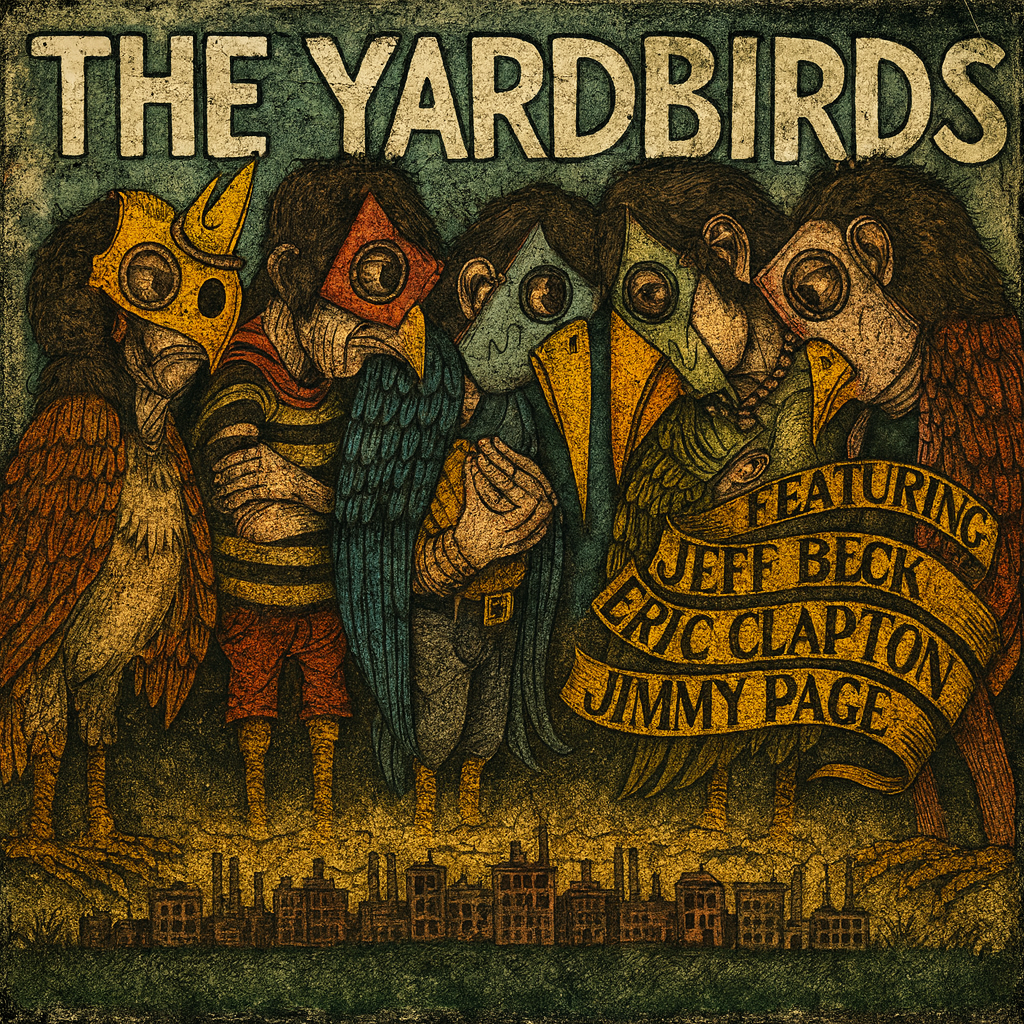
Before distortion had a name, before arena tours and stacks of Marshalls, there was a smoky cellar in Richmond, England, where blues ghosts whispered to teenage boys in torn trousers.

It was 1963, and The Yardbirds were just another scrappy R&B band looking for gigs in a post-war landscape still rationing electricity. But something in their DNA glowed radioactive. At the center of their sound was a holy-grail quest to redefine the electric guitar.

Eric Clapton was the first chosen one. Rail-thin and sharp-featured, with a stare that could slice tape. A blues obsessive, Clapton didn’t just admire Muddy Waters—he believed in him. To Eric, the guitar was sacred. No gimmicks. No compromise.

His solos weren’t performances; they were prayers. And for a time, The Yardbirds carried that fire.

But when the band dared to flirt with pop—recording “For Your Love,” with its eerie harpsichord and suspicious commercial promise—Clapton packed his case and walked. He refused to watch the blues get sold like bubblegum.

The band barely blinked.

They found a madman to replace him.

Jeff Beck wasn’t interested in prayers. He plugged in like lightning, coaxing squeals and feedback that sounded like broken radios from the future. He made his guitar speak a new language—half machine, half spirit animal.

To the rest of the band, Beck was a marvel and a menace. He’d show up late, or not at all. Sometimes he’d bash his amp mid-solo, not out of frustration but because he liked the sound it made.

It was Jeff who made distortion beautiful. Jeff who showed a generation that the guitar wasn’t just a tool—it was a weapon, a mirror, a hallucination.

Enter Jimmy Page, watching from the wings.

At first he declined to join. He was a top session man—anonymous but revered—and didn’t want the chaos. But eventually the pull was too strong. He joined as bassist at first, then co-guitarist, then inheritor of the ashes.

Where Clapton had purity and Beck had magic, Page had vision. A mind that saw not just songs but worlds. He didn’t want to play a great solo. He wanted to build sonic temples.

For a brief moment, Beck and Page shared the stage—twin comets hurtling toward some musical singularity. The band couldn’t handle it: two wizards, one cauldron. The fuse burned fast, and The Yardbirds dissolved.

But something lingered in the air—an aftershock, a frequency only Page seemed to hear.

Something heavier gathering in the dark.
Something mythic.
Something waiting to be named.

This wasn’t The Yardbirds anymore.


Ranking the Led Zeppelin Catalog

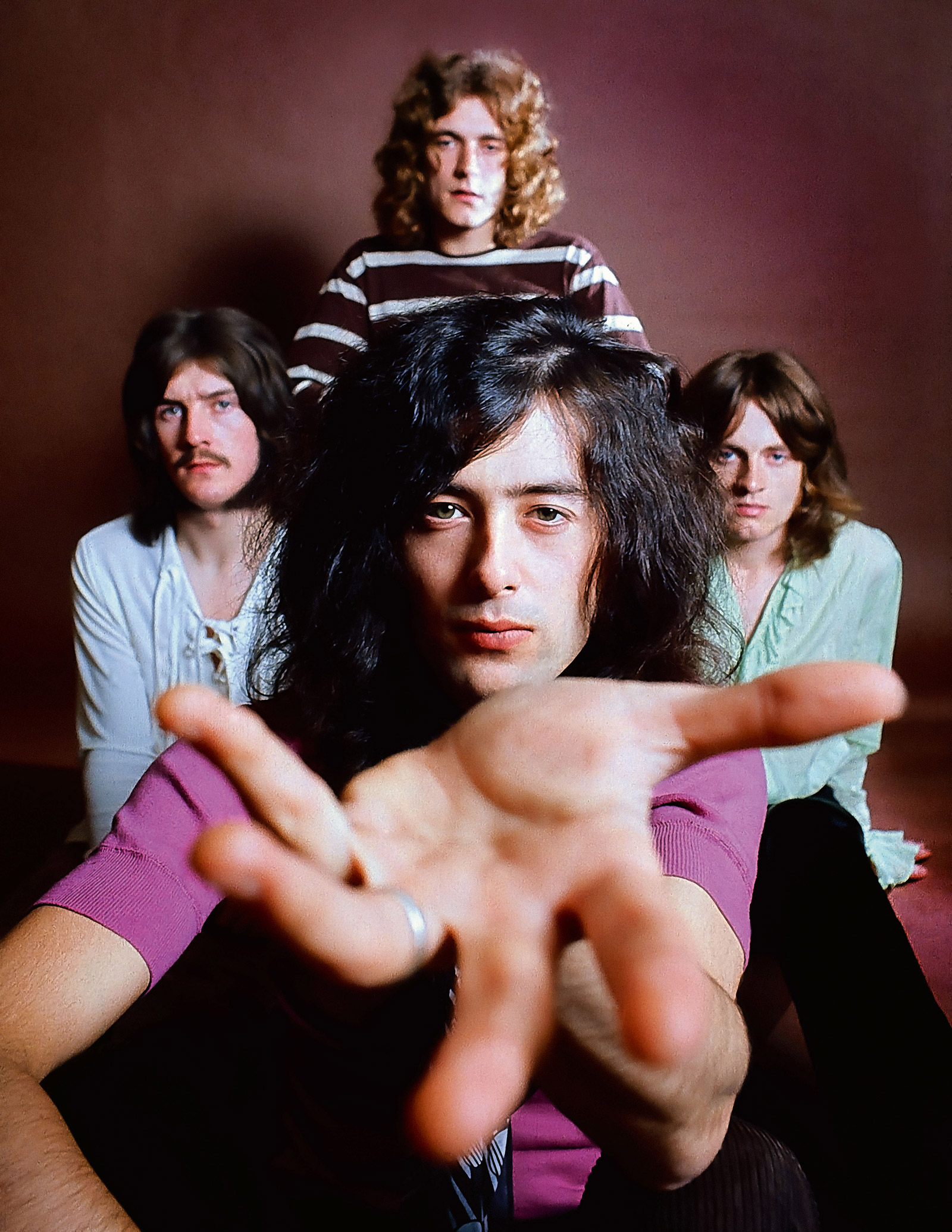
Before the loudest generation found its own voice, it inherited the thunder of the previous generation. And no voice thundered louder than Led Zeppelin.

Led Zeppelin created a legacy that influenced countless musicians and genres. Their catalog is a mix of raw power and groundbreaking experimentation. Jimmy Page’s production was as essential to Led Zeppelin’s legacy as his guitar playing and his songwriting.

Ranking the albums of Led Zeppelin is no easy task, but here’s my take—from prime howl to final whisper.

1. Led Zeppelin IV (1971)

It’s impossible to talk about Led Zeppelin without mentioning their fourth album. This is the temple where all who seek the divine in music come to kneel. Andy Johns, a young but prodigious engineer, worked tirelessly alongside Page capturing the thunderous drums of “When the Levee Breaks” by placing John Bonham’s kit at the bottom of a stairwell, miking it from above to achieve that apocalyptic reverb.

“Stairway to Heaven” has transcended rock to become a cultural touchstone. “Black Dog,” “Rock and Roll,” “Misty Mountain Hop”—each a proclamation of the band’s heavy rock authority.

“The Battle of Evermore” introduces a new dimension entirely—an eerie English folk ballad steeped in mysticism. With Sandy Denny’s ghost-like vocals entwined with Plant’s, it becomes a duet of prophecy and lament.

“Going to California” strips everything back—a moment of quiet wonder, wistful and weightless, carried by Page’s delicate fingerpicking. In a sea of titanic riffs, it is a quiet revelation.

2. Led Zeppelin II (1969)

Led Zeppelin II” is where the band truly found their voice, combining blues, hard rock, and psychedelia into a sound that would define a generation. “Whole Lotta Love,” with its iconic riff and explosive middle section, is a landmark in rock music. The album is raw, powerful, and unrelenting—a true classic that set the stage for everything that followed.

It was engineer Eddie Kramer, who helped forge Led Zeppelin II into a masterpiece of raw, unbridled power. Kramer, already a legend for his work with Jimi Hendrix, was the perfect accomplice for Page’s rebellion against the polished, overproduced sounds of the era.

The album is raw, unrelenting, the essence of blues transcended into something altogether more dangerous. Here is the sound of a band discovering the magnitude of its own power and reveling in it, unburdened by consequence.

3. Physical Graffiti (1975)

“Physical Graffiti” showcases everything Led Zeppelin does best. From the epic “Kashmir” to the bluesy “In My Time of Dying” and the rock ‘n’ roll of “Trampled Under Foot,” it’s an album that covers vast musical ground. Every track is a highlight, making it one of the most complete and ambitious albums in rock history.

As producer, Page faced the daunting task of curating a double album that spanned years of recordings. He sifted through tapes, resurrecting forgotten tracks. “Kashmir” is its great anthem, a march of conquerors across some windswept desert of the mind. Ron Nevison, known for his work on The Who’s Quadraphenia, helped Page layer the strings and Mellotron, and ensured that the track’s grandeur never overwhelmed its intimacy.

Physical Graffiti is the last moment before excess would become a burden, the last pure expression of the band’s boundless ambition.

4. Led Zeppelin I (1969)

The birth of something terrible and great. It was here that the first notes rang out, that the first omens were spoken. The blues is here, but it has been twisted into something more dangerous, something wild. It is the lightning before the storm, the first breath before the plunge.

Glyn Johns stood beside Jimmy Page in those early, formative days— the engineer who helped shape the raw, primal sound of Led Zeppelin I. Johns, already a respected figure in the British music scene for his work with The Rolling Stones and The Beatles, was the perfect collaborator for Page’s vision. Together, they transformed a shoestring budget into a seismic event, capturing the band’s ferocious energy and untamed spirit.

5. Led Zeppelin III (1970)

A retreat, but not a surrender. In these songs, the band turns inward, seeking wisdom in quieter places. “Immigrant Song” is the lone war cry, but the rest is introspective, a reckoning with folklore and tradition. “That’s the Way” aches with nostalgia, the dreamlike “Tangerine”—imbued with a sense of warmth and nostalgia, as if each note were a memory fading into mist.

Jimmy Page, along with engineer Andy Johns, captured a delicate and intimate side of Zeppelin—layering acoustic guitars, mandolins, and open space into the mix. These quieter moments were imbued with warmth and memory, as if each note were a fading photograph.

Led Zeppelin III doesn’t abandon power; it transforms it. The result is a strange alchemy: music that sounds like a storm that chose to whisper instead of break.

6. Houses of the Holy (1973)

This is the experiment, the moment when the beast changes its form and begins to shapeshift. Gone is the pure fury of the early days; in its place is something more peculiar. “The Rain Song” is delicate, mournful, a meditation on time and loss. “No Quarter” is the descent into shadow, the creeping knowledge of one’s own mortality.

The sonic architect behind Houses of the Holy was Eddie Kramer, a man whose hands touched some of the most revered recordings in rock history. On Houses of the Holy, Kramer’s role was that of a guide through Zeppelin’s most experimental impulses. The lush, cascading reverbs of The Rain Song—its melancholy floating in space like a memory slipping through time—owe as much to Kramer’s deft hand as to Page’s arrangements. No Quarter, a ghostly dirge, is drenched in eerie effects, its piano and vocals emerging from some spectral void, the product of Kramer’s studio mastery.

“Houses of the Holy” is a kaleidoscope of styles, from the reggae-tinged “D’yer Mak’er” to the funky “The Crunge.” It’s an album that refuses to be pigeonholed, showing Led Zeppelin’s willingness to experiment and push boundaries. While not as cohesive as their earlier work, it’s a bold statement of a band at the height of their creative powers.

7. In Through the Out Door (1979)

For the first time in Zeppelin’s history, the studio was no longer Page’s undisputed dominion. The band was fraying, and the balance of power had shifted. With Page consumed by addiction and Bonham spiraling into self-destruction, bassist John Paul Jones stepped into a new role—emerging as the guiding force behind the album’s direction alongside Robert Plant.

Jimmy Page remained the credited producer, but it was Jones’ synthesizers, arrangements, and melodic sensibilities that defined the album’s character. Engineering duties fell to Leif Mases, a Swedish producer and sound engineer known for his work with ABBA. His approach lent the album a clarity and polish previously unseen in Zeppelin’s catalog.

Unlike the cavernous, mythical depth of Physical Graffiti or Houses of the Holy, In Through the Out Door is almost clinical in its production—clean, precise, and notably keyboard-driven. The mix is pristine, the performances polished. The rough, untamed edges of Zeppelin’s earlier albums are absent, replaced by a sheen that reflects the band’s internal shift—toward pop, toward introspection, toward an uncertain future.

8. Presence (1976)

Presence is Zeppelin stripped to the bone. Made during a time of illness, legal battles, and exhaustion, the album carries a raw, wounded energy. Achilles Last Stand opens like a war cry—defiant. The rest is skeletal, stripped of ornamentation, an album made in desperation.

Recorded in just 18 days at Munich’s sterile Musicland Studios, Page took full control, producing at a fever pitch to hold the band together. The cold, metallic sharpness of the mix mirrors the atmosphere: no mythic haze, no layered opulence—just galloping guitars and relentless rhythms. Keith Harwood’s engineering stripped away any illusion, leaving behind something almost harsh in its honesty.

Presence has no radio-friendly hooks, no singalong anthems—just tension and survival. Nobody’s Fault but Mine crackles with desperation; Tea for One isn’t reflective, it’s mournful. This is Zeppelin in freefall—but they fall with fire, clawing at gravity until the very end.

9. Coda (1982)

A fragment, a whisper of things unfinished. The work of ghosts, of men who were once gods. Coda is a collection of outtakes and rarities, released after John Bonham’s tragic death. It is an epilogue, tinged with sorrow—the kind that comes from remembering what once was and knowing it will never be again.

After Bonham’s death in 1980 and the dissolution of Led Zeppelin, Atlantic Records was still owed one final album. And so, Page and Plant returned—not to create, but to excavate. This was an album of aftershocks, a collection of studio remnants spanning from Led Zeppelin III to In Through the Out Door, assembled into a last, reluctant farewell.

“Wearing and Tearing” thrashes like a ghost that still wants to fight. It’s a glimpse of what might have come next—a defiant voice from beyond the grave.

If Coda feels incomplete, it’s because it was never meant to be whole. It is the last ripple of a wave that had already crashed, the echo of thunder already spent. A final glimpse of Led Zeppelin as they once were, before time and tragedy took their toll.

Ranking Van Halen’s First Six Albums

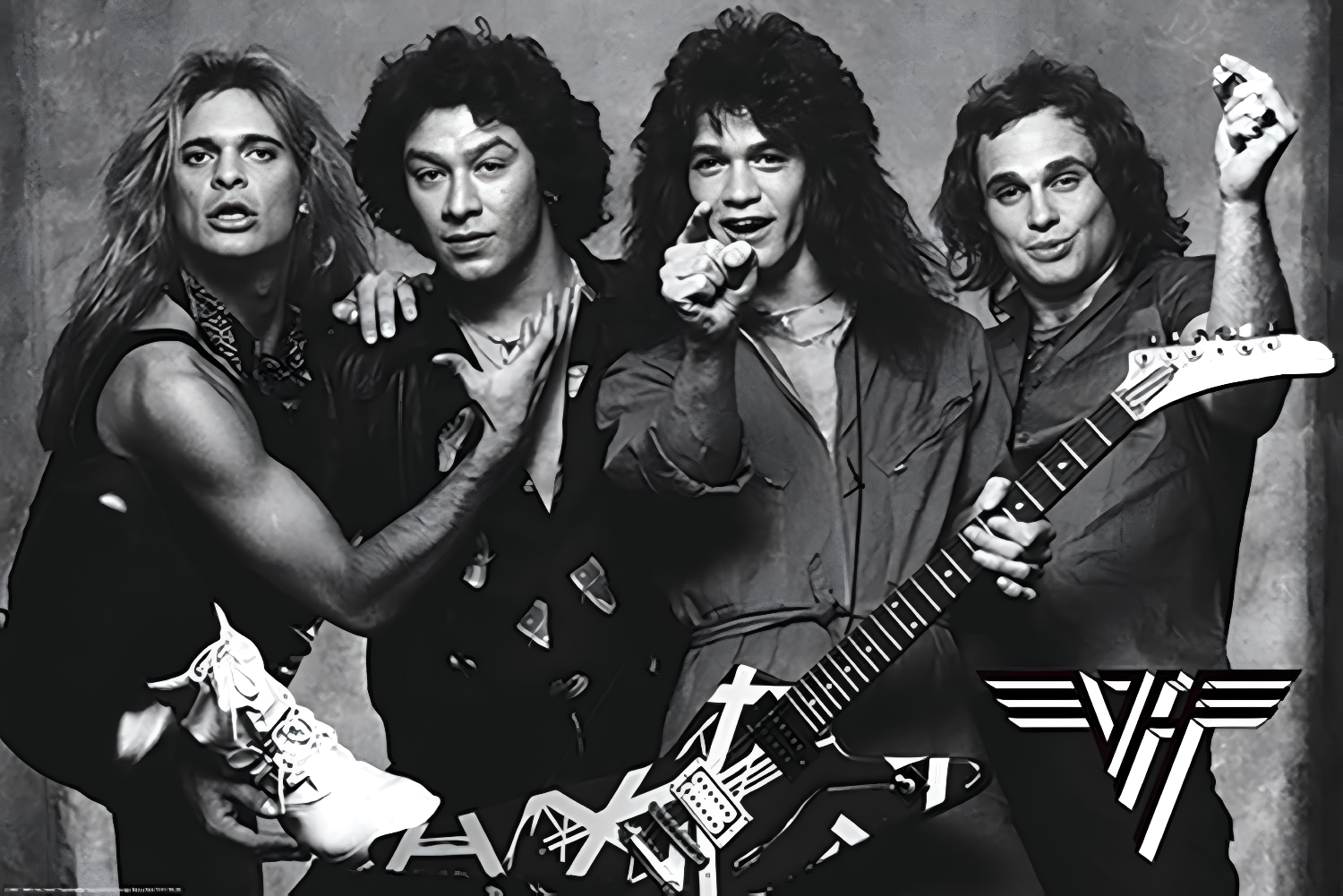
It is said that music, like fate, reveals itself in waves—at times crashing in violent upheaval, at times receding into quiet memory. Van Halen, this band of jesters, did not just play rock ‘n roll, they embodied a reckless, divine laughter.

Their first six albums are an unchained rebellion against—well, what’ve you got? And so, in the spirit of inquiry and self-reflection, let us examine these works in order of importance.


I. Van Halen (1978)

It begins as all revelations do: with a single, devastating truth. In this case, it is Eruption, a sound so unearthly, so violent in its execution, that it is less a song and more a vision—a man staring into the face of God. Eddie Van Halen’s playing is a force climbing skyward—each phrase fighting against gravity, demanding effort, energy, and belief.  It’s an affront to the established order of rock, a thing that should not be.

Yet it does not end there. Van Halen as a whole is not simply a collection of revelatory solos but a treatise on the fundamental nature of ecstasy and despair. The gallows humor of Runnin’ with the Devil, the desperate yearning of Ain’t Talkin’ ‘Bout Love, the mad revelry of Jamie’s Cryin’—this album is an exploration of man’s folly, his insatiable desire, and his inevitable suffering. Even in its lesser-known passages—Feel Your Love TonightI’m the OneLittle Dreamer—there is a hunger, a drive, a fire that refuses to be extinguished.

II. Women and Children First (1980)

The revelry continues, but here, it darkens. Women and Children First is a howl of defiance, a declaration that while the world may erode the spirit, one must still dance upon the ruins.

Songs such as And the Cradle Will Rock… and Everybody Wants Some!! present themselves as anthems for the damned, for those who see the world’s absurdity yet refuse to submit to despair. In Fools and Romeo Delight, Eddie’s guitar ceases to be an instrument and becomes an act of war, an assertion that to yield is to die. Meanwhile, Could This Be Magic? offers a moment of surreal, almost cynical reprieve, as if to mock the very notion of sincerity in a world so bent on deception.

III. Van Halen II (1979)

But there is always a moment when the condemned man forgets his chains, when the prisoner laughs despite his suffering. Van Halen II is such a moment—a reprieve, a seduction, a fleeting indulgence in the illusion of happiness.

Dance the Night Away is hedonism in its purest form, an invitation to cast aside burdens and simply beBeautiful Girls is not a love song but an exultation of beauty, of pleasure, of that which we know will not last but must be celebrated nonetheless. Even in Spanish Fly, an acoustic marvel, we hear not just skill, but delight—as if Eddie, for a moment, has allowed himself to exist outside the pressures of greatness and simply play.

IV. Fair Warning (1981)

It was inevitable. No laughter lasts forever. No light can burn without casting shadows. And so we come to Fair Warning, the sound of revelry curdling into regret.

From the opening of Mean Street, we hear not the triumphant strut of the gambler, but the weary gait of the man who has lost it all. Unchained, for all its defiant energy, is no longer the voice of the carefree youth—it is the voice of the man who fights because he must, who rages because surrender is unthinkable. The beauty of Push Comes to Shove is not in its melody but in its melancholy—a slow, creeping awareness that the dance is nearing its end.

This is a great album, but it is not a happy one. And it should not be.

V. 1984 (1984)

And now the great turning. 1984 is not merely a shift in sound, but in philosophy. The synthesizers, the sleek production, the blinding neon of Jump—this is not rebellion, but assimilation. The wild creature of Van Halen has been put in a cage, and given a treat.

It is not without its virtues. Panama and Hot for Teacher still pulse with the old spirit. Eddie’s solos remain untouched by time. But something has been lost here. Or rather, something has been willingly given up. The freedom that once defined Van Halen has now been sold, traded for a throne in a kingdom of illusions.

VI. Diver Down (1982)

Finally, we arrive at Diver Down, the album that smiles even as it bleeds. It is, in many ways, a jest—a record filled with covers, diversions, distractions. Even its best moments—Little GuitarsSecrets—feel as if they are spoken by a man who does not wish to speak of his suffering, who would rather entertain than confess.

But even here, in this playful deceit, we find truth. Big Bad Bill (Is Sweet William Now) is a moment of warmth, an acknowledgment that even the wildest of men may one day long for quiet. It is a farewell to something—not just to a certain sound, but to an era.

Locked Inside Pink Floyd’s Wall

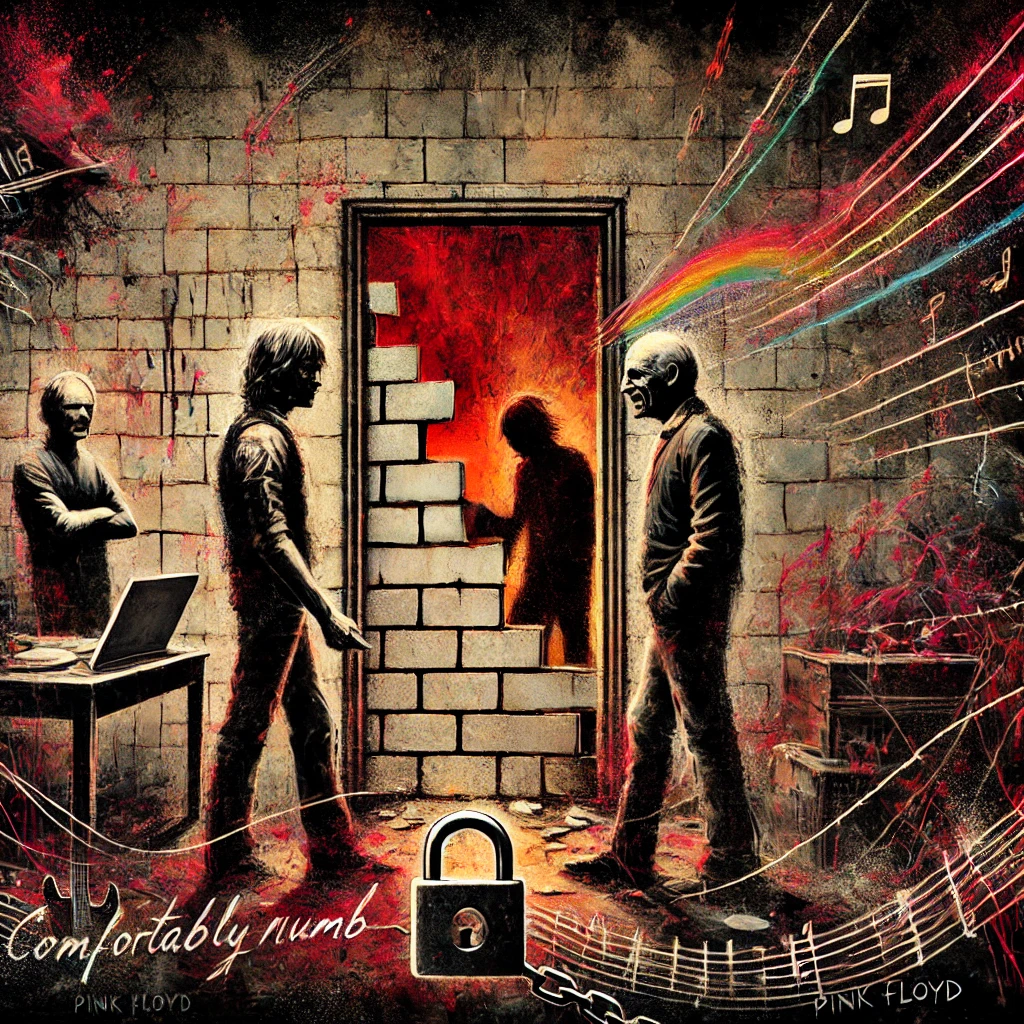
Los Angeles, late 1979. A dimly lit control room in Producers Workshop.

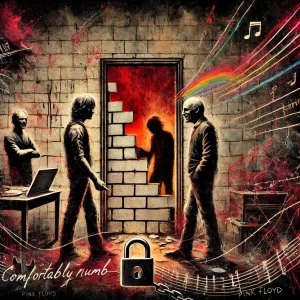
Roger Waters and David Gilmour are locked in yet another shouting match—this time over Comfortably Numb.

“The verses need to be dry, stripped down. No big, emotional swill!” Waters insists, voice sharp, eyes burning.

Gilmour scoffs. “You’re killing the song! The chorus needs to soar, Roger! It’s the climax of the whole bloody thing!”

Their words ricochet off the walls, their frustrations festering. This isn’t just a disagreement—it’s a battle of wills, the latest in a long war that’s been raging since The Wall began taking shape.

In the middle of it all, Bob Ezrin rubs his temples, trying to keep his patience. He’s seen this before—two brilliant artists colliding, their egos clashing with their genius. But this time, he’s had enough.

Without a word, he walks over to the door. Click. The lock turns.

“Alright,” Ezrin says, voice calm, measured. “Nobody leaves until we get this right.”

A tense silence falls over the room. The two Pink Floyd leaders stare at him, dumbfounded.

“What the hell are you doing?” Waters snaps.

Ezrin meets his glare, unflinching. “You’re both wrong. And you’re both right. We’re going to do it my way.”

The room stays still. No one moves. No one speaks.

But Ezrin is about to make his stand.

No discussion of The Wall can start anywhere other than Roger Waters. This was his album, his story, his rage and disillusionment poured into music. By the late ‘70s, he was growing increasingly detached—from audiences, from bandmates, from the very notion of rock stardom itself. The seeds of The Wall were planted in 1977, when, during a Pink Floyd concert, he became so uncomfortable with the crowd’s behavior that he fantasized about building a literal wall between himself and them.

That moment of alienation sparked something in Waters. He envisioned an album that would explore themes of psychological isolation, personal trauma, and the dangerous allure of authoritarianism. Drawing from his own experiences—including the death of his father in World War II, a strained education system, and the pressures of fame—Waters crafted a narrative that was part autobiography, part dystopian nightmare.

With The Wall, he wasn’t just writing an album—he was building an entire world.

Waters may have had the vision, but the scale of it was overwhelming. Enter Bob Ezrin.

Ezrin wasn’t just there to produce—he was there to refine, to shape, to ensure that The Wall wasn’t just an indulgent, sprawling mess. When Waters presented his ideas, Ezrin made a bold suggestion:

“We need a script. Not just a track list—a real, structured narrative.”

At first, Waters resisted. He was fiercely protective of his work, reluctant to let anyone else shape its form. But Ezrin knew the power of storytelling, and he fought for the structure that would keep The Wall from collapsing under its own weight. He insisted on treating the album like a Broadway show, mapping out scenes, defining character arcs, and ensuring that each song served a larger narrative purpose.

It was Ezrin who brought in the school choir for Another Brick in the Wall, Part 2, convincing Waters that it would add a layer of eerie, detached rebellion. It was Ezrin who fought for pacing, making sure the album ebbed and flowed with the right tension. And it was Ezrin who, when Gilmour and Waters clashed over Comfortably Numb, made the call that would turn it into a masterpiece.

If The Wall was Waters’ story, then Gilmour provided the voice that made it sing. The creative tension between them was both the album’s greatest strength and its biggest obstacle.

Waters brought the raw, emotional intensity—lyrics drenched in paranoia and discomfort. Gilmour brought the soaring, melodic beauty—those ethereal guitar solos that felt like moments of breaking through despair. Together, they created some of the most iconic music in rock history.

But that tension was volatile.

And in Comfortably Numb, it came to a head.

Gilmour’s original demo was melancholic yet lush, its chord progression haunting and hypnotic. Waters, ever the minimalist, wanted it stripped down, stark, almost lifeless. Gilmour wanted it grand, cinematic.

Ezrin, watching two geniuses at odds, made his choice.

The tension in the studio is unbearable. Waters and Gilmour are still glaring at each other, neither willing to give an inch.

Ezrin exhales. “Roger, the verses stay your way—dry, detached, almost lifeless. That fits the story. But David’s chorus? It stays massive. Orchestral. Emotional.”

Silence.

Then, Waters sighs, running a hand through his hair. He relents.

Gilmour nods, arms crossed, still fuming, but willing to trust the man who had already shaped so much of The Wall.

Ezrin unlocks the door. “Alright,” he says. “Now let’s make history.”

And they do.

The final version of Comfortably Numb becomes one of the defining moments of The Wall, the contrast between the bleak verses and the soaring chorus cementing its place in rock history.

By the time The Wall was completed, Roger Waters had asserted near-total dominance over Pink Floyd. Richard Wright had been fired during recording, Nick Mason was largely uninvolved, and Gilmour and Waters’ relationship was beyond repair. The album’s sheer ambition had pushed everyone to the breaking point.

But The Wall wasn’t just finished—it became a cultural landmark. It went on to sell over 30 million copies worldwide, define an era of rock music, and inspire one of the most ambitious tours in history.

Today, The Wall is remembered as Waters’ magnum opus—a deeply personal, deeply political statement wrapped in some of the most haunting and beautiful music ever recorded. But its greatness also lies in the delicate balance of vision, musicianship, and production.

Waters built The Wall. Ezrin made it stand. Gilmour gave it its soul.

And for a brief, tense moment in a locked studio, they all worked together to make history.
What the Hell Is My Sharona?!

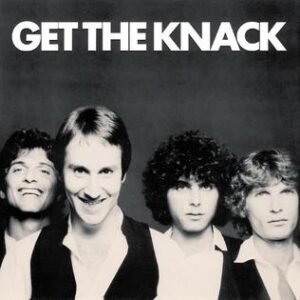
What is youth but the delirium of dreams, the reckless fumble toward ecstasy before the world crushes you into submission? Get the Knack is precisely such a delirium—brash and unrepentant in its yearning for something beyond itself.

The opening moments of Let Me Out announce themselves with a frantic urgency, a will to break free from the suffocation of ordinary life. The guitars drive forward like the pulse of a young man gripped by hunger, not only for pleasure, but for conquest.

What is My Sharona? What is this song if not obsession itself? Doug Fieger’s voice is that of a lover and a tyrant, pleading yet demanding, a desperate suitor on the edge of sanity. Sharona, the eternal woman, the phantom that lures and destroys, the archetype of all desire that can never be fully satisfied.

But passion never exists without the shadow of its own decline. Good Girls Don’t flirts with provocation, but in its smirking bravado lies a deeper truth, the clash between ideals and desire, restraint and indulgence. Purity, if it ever existed, is long gone. Even love, even music, carries within it the seeds of its own unraveling.

She’s So Selfish? What venom, what accusation! And yet, is it not a mirror of ourselves? Do we not all grasp for what we desire, leaving the rest to wither? Is there no fairness in human affairs—only power, only will, only the hungering void that each soul seeks to fill before it is cast aside.

But let us not be fooled into thinking Get the Knack is a mindless revelry. Beneath its exuberant energy lurks a darker undercurrent. The late 1970s, a world staggering under the weight of lost idealism. The children of the counterculture, grown weary, cynical. The revolutionaries of the ’60s, now bureaucrats and broken men. Beneath the infectious hooks and musicianship lies the desperate laughter of a generation aware of its own futility.

And yet, is it not uniquely human to laugh even as the noose tightens? Get the Knack does not offer answers, nor does it seek to. It merely plunges forward, driven by its own manic energy, a bright flame against the oncoming dark.