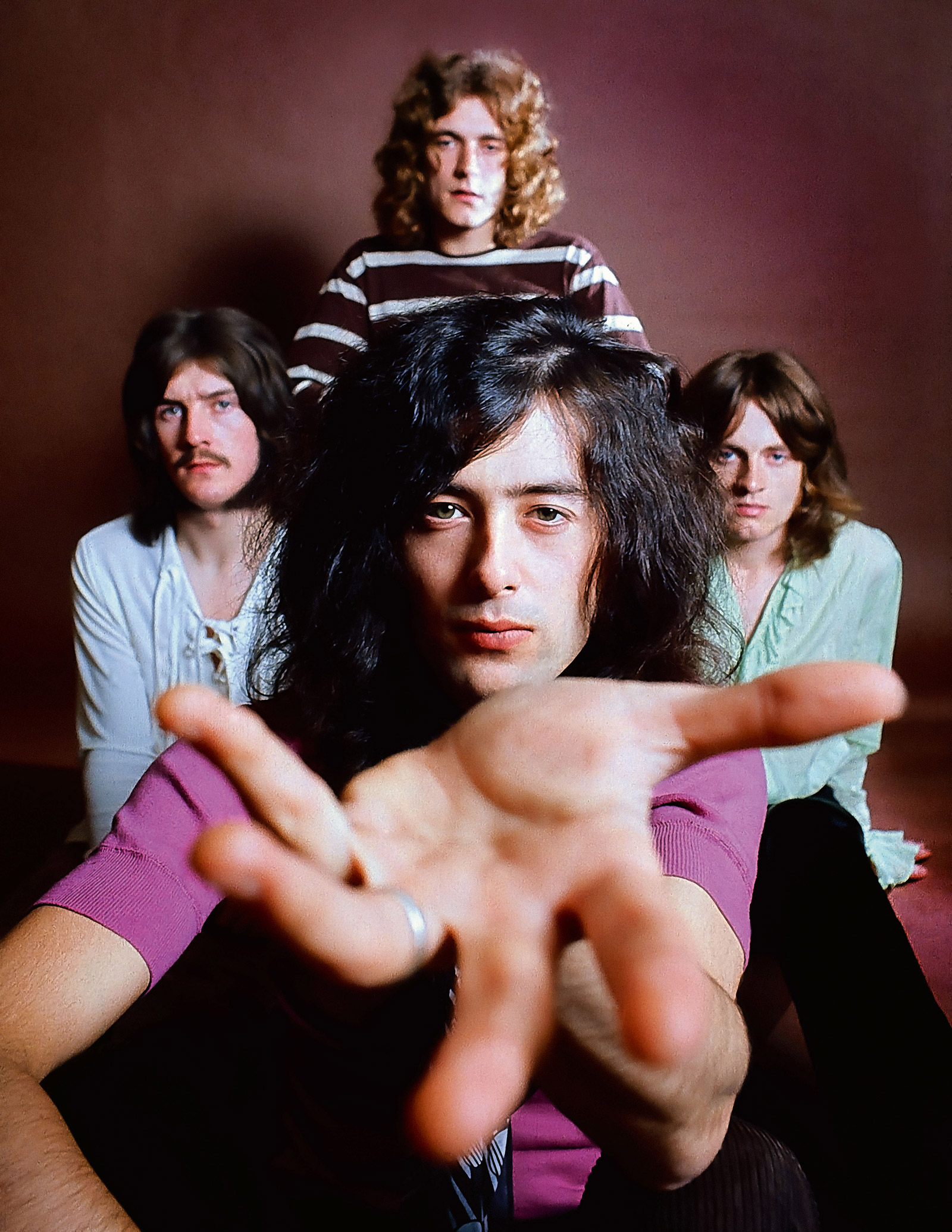
Before the loudest generation found its own voice, it inherited the thunder of the previous generation. And no voice thundered louder than Led Zeppelin.
Led Zeppelin created a legacy that influenced countless musicians and genres. Their catalog is a mix of raw power and groundbreaking experimentation. Jimmy Page’s production was as essential to Led Zeppelin’s legacy as his guitar playing and his songwriting.
Ranking the albums of Led Zeppelin is no easy task, but here’s my take—from prime howl to final whisper.
1. Led Zeppelin IV (1971)
It’s impossible to talk about Led Zeppelin without mentioning their fourth album. This is the temple where all who seek the divine in music come to kneel. Andy Johns, a young but prodigious engineer, worked tirelessly alongside Page capturing the thunderous drums of “When the Levee Breaks” by placing John Bonham’s kit at the bottom of a stairwell, miking it from above to achieve that apocalyptic reverb.
“Stairway to Heaven” has transcended rock to become a cultural touchstone. “Black Dog,” “Rock and Roll,” “Misty Mountain Hop”—each a proclamation of the band’s heavy rock authority.
“The Battle of Evermore” introduces a new dimension entirely—an eerie English folk ballad steeped in mysticism. With Sandy Denny’s ghost-like vocals entwined with Plant’s, it becomes a duet of prophecy and lament.
“Going to California” strips everything back—a moment of quiet wonder, wistful and weightless, carried by Page’s delicate fingerpicking. In a sea of titanic riffs, it is a quiet revelation.
2. Led Zeppelin II (1969)
“Led Zeppelin II” is where the band truly found their voice, combining blues, hard rock, and psychedelia into a sound that would define a generation. “Whole Lotta Love,” with its iconic riff and explosive middle section, is a landmark in rock music. The album is raw, powerful, and unrelenting—a true classic that set the stage for everything that followed.
It was engineer Eddie Kramer, who helped forge Led Zeppelin II into a masterpiece of raw, unbridled power. Kramer, already a legend for his work with Jimi Hendrix, was the perfect accomplice for Page’s rebellion against the polished, overproduced sounds of the era.
The album is raw, unrelenting, the essence of blues transcended into something altogether more dangerous. Here is the sound of a band discovering the magnitude of its own power and reveling in it, unburdened by consequence.
3. Physical Graffiti (1975)
“Physical Graffiti” showcases everything Led Zeppelin does best. From the epic “Kashmir” to the bluesy “In My Time of Dying” and the rock ‘n’ roll of “Trampled Under Foot,” it’s an album that covers vast musical ground. Every track is a highlight, making it one of the most complete and ambitious albums in rock history.
As producer, Page faced the daunting task of curating a double album that spanned years of recordings. He sifted through tapes, resurrecting forgotten tracks. “Kashmir” is its great anthem, a march of conquerors across some windswept desert of the mind. Ron Nevison, known for his work on The Who’s Quadraphenia, helped Page layer the strings and Mellotron, and ensured that the track’s grandeur never overwhelmed its intimacy.
Physical Graffiti is the last moment before excess would become a burden, the last pure expression of the band’s boundless ambition.
4. Led Zeppelin I (1969)
The birth of something terrible and great. It was here that the first notes rang out, that the first omens were spoken. The blues is here, but it has been twisted into something more dangerous, something wild. It is the lightning before the storm, the first breath before the plunge.
Glyn Johns stood beside Jimmy Page in those early, formative days— the engineer who helped shape the raw, primal sound of Led Zeppelin I. Johns, already a respected figure in the British music scene for his work with The Rolling Stones and The Beatles, was the perfect collaborator for Page’s vision. Together, they transformed a shoestring budget into a seismic event, capturing the band’s ferocious energy and untamed spirit.
5. Led Zeppelin III (1970)
A retreat, but not a surrender. In these songs, the band turns inward, seeking wisdom in quieter places. “Immigrant Song” is the lone war cry, but the rest is introspective, a reckoning with folklore and tradition. “That’s the Way” aches with nostalgia, the dreamlike “Tangerine”—imbued with a sense of warmth and nostalgia, as if each note were a memory fading into mist.
Jimmy Page, along with engineer Andy Johns, captured a delicate and intimate side of Zeppelin—layering acoustic guitars, mandolins, and open space into the mix. These quieter moments were imbued with warmth and memory, as if each note were a fading photograph.
Led Zeppelin III doesn’t abandon power; it transforms it. The result is a strange alchemy: music that sounds like a storm that chose to whisper instead of break.
6. Houses of the Holy (1973)
This is the experiment, the moment when the beast changes its form and begins to shapeshift. Gone is the pure fury of the early days; in its place is something more peculiar. “The Rain Song” is delicate, mournful, a meditation on time and loss. “No Quarter” is the descent into shadow, the creeping knowledge of one’s own mortality.
The sonic architect behind Houses of the Holy was Eddie Kramer, a man whose hands touched some of the most revered recordings in rock history. On Houses of the Holy, Kramer’s role was that of a guide through Zeppelin’s most experimental impulses. The lush, cascading reverbs of The Rain Song—its melancholy floating in space like a memory slipping through time—owe as much to Kramer’s deft hand as to Page’s arrangements. No Quarter, a ghostly dirge, is drenched in eerie effects, its piano and vocals emerging from some spectral void, the product of Kramer’s studio mastery.
“Houses of the Holy” is a kaleidoscope of styles, from the reggae-tinged “D’yer Mak’er” to the funky “The Crunge.” It’s an album that refuses to be pigeonholed, showing Led Zeppelin’s willingness to experiment and push boundaries. While not as cohesive as their earlier work, it’s a bold statement of a band at the height of their creative powers.
7. In Through the Out Door (1979)
For the first time in Zeppelin’s history, the studio was no longer Page’s undisputed dominion. The band was fraying, and the balance of power had shifted. With Page consumed by addiction and Bonham spiraling into self-destruction, bassist John Paul Jones stepped into a new role—emerging as the guiding force behind the album’s direction alongside Robert Plant.
Jimmy Page remained the credited producer, but it was Jones’ synthesizers, arrangements, and melodic sensibilities that defined the album’s character. Engineering duties fell to Leif Mases, a Swedish producer and sound engineer known for his work with ABBA. His approach lent the album a clarity and polish previously unseen in Zeppelin’s catalog.
Unlike the cavernous, mythical depth of Physical Graffiti or Houses of the Holy, In Through the Out Door is almost clinical in its production—clean, precise, and notably keyboard-driven. The mix is pristine, the performances polished. The rough, untamed edges of Zeppelin’s earlier albums are absent, replaced by a sheen that reflects the band’s internal shift—toward pop, toward introspection, toward an uncertain future.
8. Presence (1976)
Presence is Zeppelin stripped to the bone. Made during a time of illness, legal battles, and exhaustion, the album carries a raw, wounded energy. Achilles Last Stand opens like a war cry—defiant. The rest is skeletal, stripped of ornamentation, an album made in desperation.
Recorded in just 18 days at Munich’s sterile Musicland Studios, Page took full control, producing at a fever pitch to hold the band together. The cold, metallic sharpness of the mix mirrors the atmosphere: no mythic haze, no layered opulence—just galloping guitars and relentless rhythms. Keith Harwood’s engineering stripped away any illusion, leaving behind something almost harsh in its honesty.
Presence has no radio-friendly hooks, no singalong anthems—just tension and survival. Nobody’s Fault but Mine crackles with desperation; Tea for One isn’t reflective, it’s mournful. This is Zeppelin in freefall—but they fall with fire, clawing at gravity until the very end.
9. Coda (1982)
A fragment, a whisper of things unfinished. The work of ghosts, of men who were once gods. Coda is a collection of outtakes and rarities, released after John Bonham’s tragic death. It is an epilogue, tinged with sorrow—the kind that comes from remembering what once was and knowing it will never be again.
After Bonham’s death in 1980 and the dissolution of Led Zeppelin, Atlantic Records was still owed one final album. And so, Page and Plant returned—not to create, but to excavate. This was an album of aftershocks, a collection of studio remnants spanning from Led Zeppelin III to In Through the Out Door, assembled into a last, reluctant farewell.
“Wearing and Tearing” thrashes like a ghost that still wants to fight. It’s a glimpse of what might have come next—a defiant voice from beyond the grave.
If Coda feels incomplete, it’s because it was never meant to be whole. It is the last ripple of a wave that had already crashed, the echo of thunder already spent. A final glimpse of Led Zeppelin as they once were, before time and tragedy took their toll.