add_filter( 'auto_update_plugin', '__return_true' );

Space Between the Beats

The clock struck three in the somber night as the four of us journeyed towards our grand performance. In music, the space between the beats is important. Life, too, unfolds in these spaces.

The relentless snowfall painted a thick veil of white upon the perilous black ice of the mountain highway. Our windshield wipers battled valiantly, their efforts hardly enough to reveal the treacherous path that lay ahead or the abyss of the valley beside. Shrouded by dense fog, in the bitter cold, we pressed on.

Then, in an instant, a booming thud resounded through the night air. Jerome, the valiant helmsman of our carriage, grappled with the wheel as it bucked and fishtailed violently along the icy road. In the back seat, I quickly accepted the fate that seemed imminent, a fate of being reduced to nothing but a mangled mess upon the desolate highway. Next to me, Keefer raised his arms and opened his mouth in dramatic slow motion.

But, onward we pressed, albeit amidst chaos.

“By the stars, thou hast done well, my friend!” I extolled Jerome for his admirable navigation.

“I aimed for the smallest of them,” he replied earnestly. “Three creatures there were, but alas, they appeared before I could discern their presence.”

“Aye, indeed,” added Thud Pumpkin. “Fortunate it was a deer and not a towering moose, for with their long limbs, they could thrust through the very windshield.”

Nonetheless, a hundred leagues still lay between us and the next village, and our headlights had relinquished their radiance to darkness. We found ourselves bereft of warmth, frequently halting in the middle of the highway to replenish the radiator now adorned with six antler holes, spewing the lifeblood of antifreeze. With steady perseverance, we inched closer to the next haven, repairing the beleaguered radiator upon our arrival. The culmination of our efforts allowed us to grace the stage precisely as the hour struck for the grand performance.

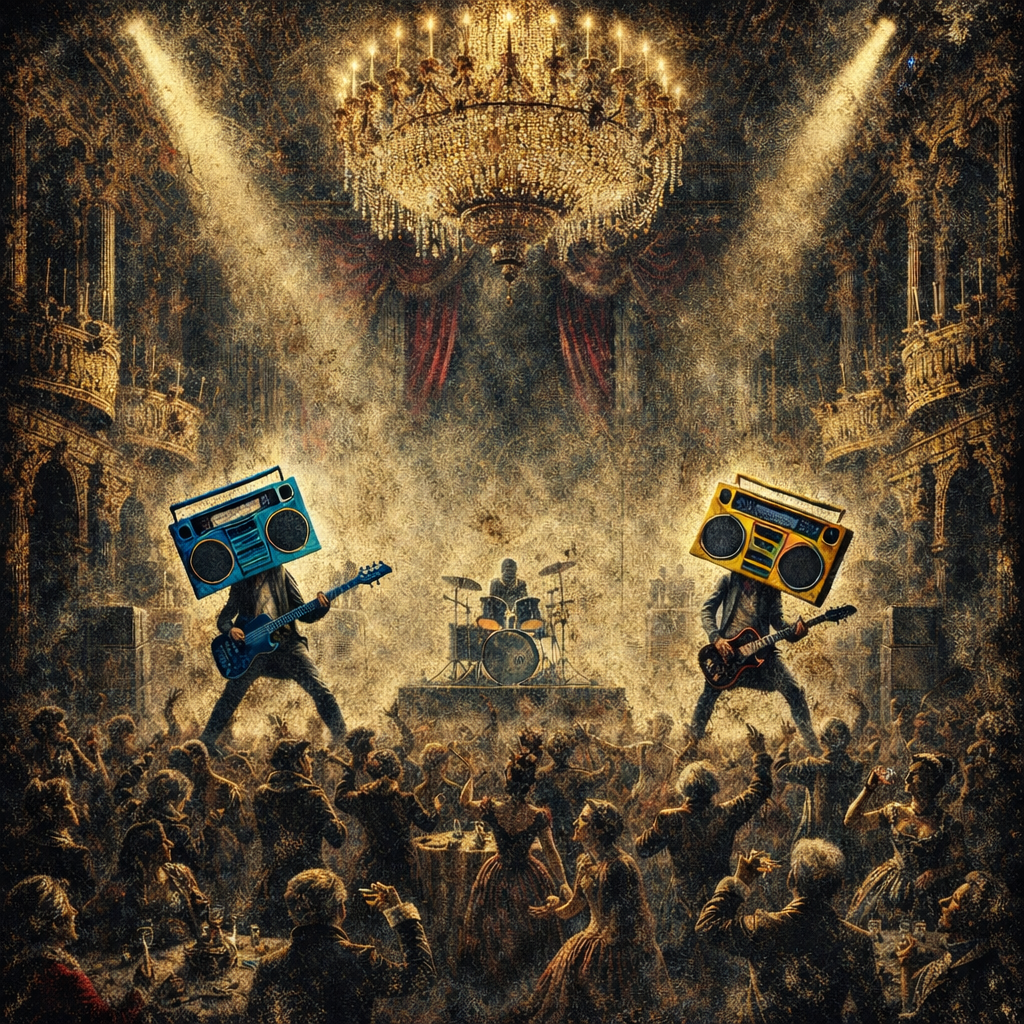
The evening greeted us with a throng that stretched for blocks, and the elixir of tequila flowed generously, akin to the flowing streams of Dionysian revelry. From the stage, we beheld the fervent punk maidens, their spirits alight with vivacious dance. As the night unfolded, Keefer and I ventured into the chamber of reflection, where a pair of shoes betrayed their presence beneath a cubicle. Curiosity beguiled Keefer, compelling him to peer over the cubicle, revealing a familiar fan. His unbuttoned sleeve, rolled past his elbow, bore witness to a needle embedded below a small tattoo of a heart with chains.

“Dude, dost it prove effective for thee?” Keefer inquired.

He seemed unaware of Keefer’s intrusion, but Keefer persisted, “Pray tell, does it avail thee, my friend?”

In that moment, I felt a gentle tap upon my shoulder. A fervent punk maiden appeared before me.

“Would you not desire to embrace me passionately?” she questioned with fervor.

“What might you offer in return?” I inquired with a measure of nonchalance.

“I knew it,” she exclaimed in excitement.

With that, we departed from the jubilant assembly and made our way back to the sanctuary of the hotel. The curtains had fallen upon the grand spectacle, and now it was time to embrace the space between the beats.
My Friend Jerome

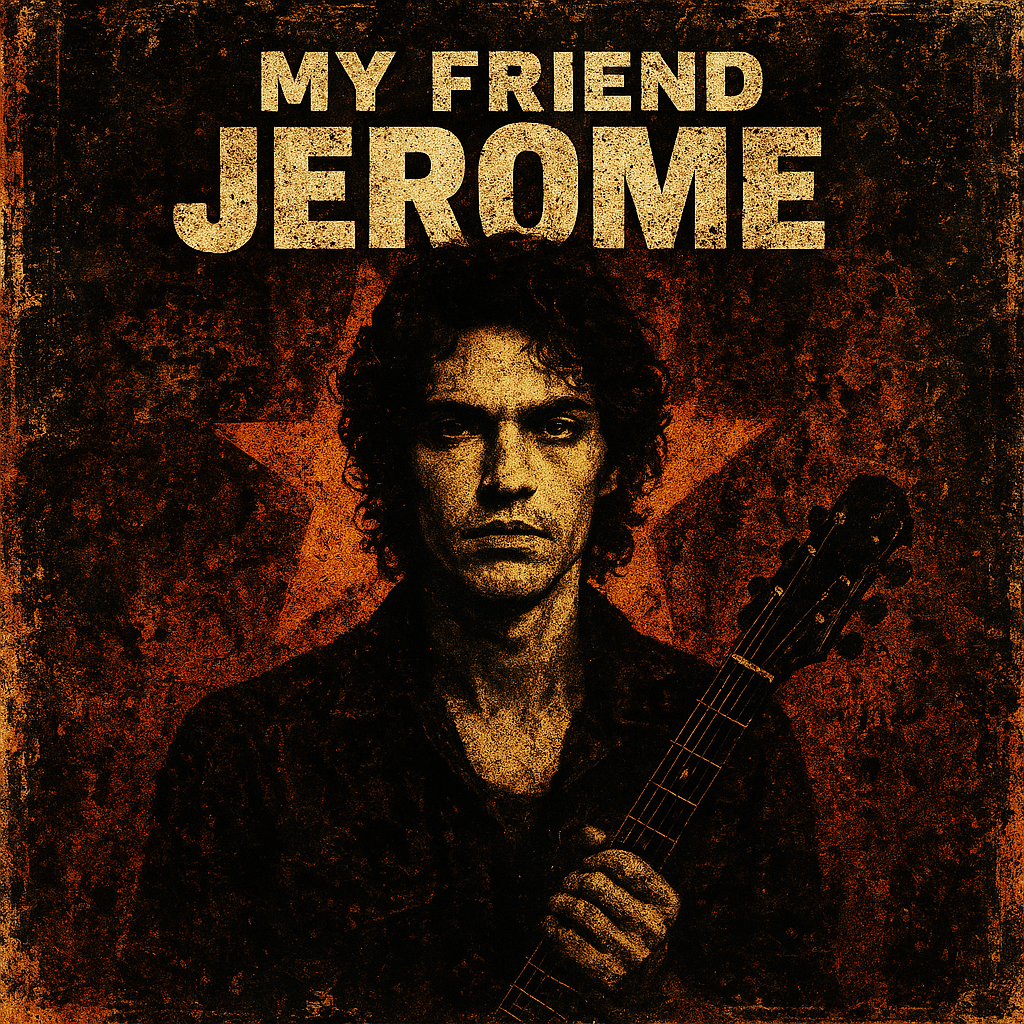
How does one speak of a legend when he is gone? How does one stand before the weight of loss and summon words mighty enough to contain his spirit? Jerome was my friend, my brother. The world may remember him as a musician, as a clone—but to me, he was something greater—a force, a star burning at its highest peak just before it vanished.

It was music that claimed him—a passion fierce and unrelenting. He pledged himself to its pursuit with the devotion of a knight. But music, as any artist will tell you, is not always a generous mistress. A man with less resolve might have faltered, turned his back on the dream for something safer, more certain.

Jerome had no grand designs of conquest, no thirst for crowns or thrones. And yet, ambition stirred within him—restless, insistent. He wanted to be a beacon, especially for the young clones drowning in the black sea of dread. He wanted to show them that they, too, could shape the world. That they could write their own legends.

So he swore himself to music with a fervor few could fathom.

His striking appearance—an unintended gift of the cloning process—was often remarked upon, yet it served him little in matters of the heart. He had grown wary of love, suspicious of its cost. He had seen too many fellow musicians surrender their art upon the altar of romance, only to watch their dreams diluted, swallowed up by the slow grind of compromise. He would not be like them. He would not be ensnared so easily. Women might admire him, but he would remain beyond their reach—his heart bound to a higher calling.

He chose solitude. But loneliness is a cunning thing. It does not arrive as an enemy, but as a whisper, creeping into the spaces left unguarded. It was in those moments of silence, when his music could not shield him, that the darkness made its case.

His life had been a relentless pursuit of a song always just beyond reach. Music had been his salvation, his war, his love.

And the women adored him—chased him like he was some untamed creature they could capture if they moved quickly enough. But Jerome was not meant to be caught. He was beautiful in the way a panther is beautiful, in the way fire is beautiful—dangerous, elusive, mesmerizing. He would lean in just close enough to make them believe they had him, then he’d smile, whisper something they’d remember for the rest of their lives, and vanish into memory. He could have had anyone, but he let himself belong to no one.

But maybe—just maybe—it wasn’t despair that took him. Maybe, in the end, Jerome did what he always wanted to do: prove, once and for all, that he was human. That he had free will. That no scientist, no pre-written sequence of DNA, could dictate his fate. In that final moment, he was a man who made his last and most irreversible choice.

A requiem was sung—not in cathedrals or concert halls, but in dimly lit nightclubs and casinos, where glasses were raised in quiet tribute.

But some of us aren’t so sure. The details were hazy. The reports, contradictory. No one ever saw the body—just rumors whispered in the clubs, strange sightings in the far corners of Northern Canada. Maybe he left, disappeared into the night, slipping away into legend like Jim Morrison, like Elvis.

Maybe he understood that true immortality isn’t in living forever—but in the stories that do.

Final Verse, First Light

Here I am, a musician in the shadows.
In these shadows is my refuge—the stage for my final performance.
Here, away from the spotlight, I find introspection and wonder.

I once immersed myself in illusions.
But no longer.
I was assertive, and took pleasure in being so.
I did not compromise my principles,
and found satisfaction in that, at least.
When young musicians sought guidance from the stage I stood upon,
I felt a strange kind of accomplishment.

But do you know the pivotal essence of my journey?

It was the revelation that—
even in uncertainty—
I was hopeful.

And so, with resolve, I continued.
The road stretched before me, winding through the familiar and the unknown.
I met fellow musicians along the way—
seekers like me, in search of their own voices.
When our paths crossed, we shared stories
of songs and saviors.
Music, always, my guide.
I found joy in these moments.

For music offers redemption.
Each verse, a kind of divine guidance—
whispers from the loving hearts of ghosts.

I believe God judges everyone fairly in the end.
And it is important to ask for forgiveness—
lest we find ourselves facing the Conductor
when the divine symphony begins.


Butcherbird

Each morning, before the sun takes full command of the sky, he sings.
The butcherbird.

Not for mates, not for territory, not for any reason nature would approve—
but for the joy of it.
The danger of it.
The mystery of it.

There is a note he favors. A single note.
Or so it seems.
Depending on how you arrive at it—on your posture, your purpose, your faith—
it can sound like salvation—or unrest.
The tritone.

To the medieval ear, it was corruption incarnate.
A sacred shape bent into disfigurement.
Something perfect gone wrong.
They called it Diabolus in Musica.
The Devil in Music.

But the butcherbird sings it like it belongs.
Casually. Joyfully. Without apology.
He does not fear the Devil’s interval. He embodies it.
Where humans once tiptoed around the tritone in candlelit choirs,
the butcherbird whistles it to the sun.
Not hidden.
Not ashamed.
Declared.

He has no theory, no name for it.
And yet his song speaks truths many composers fear to write.

Because the butcherbird knows what we try to forget:
That conflict creates.
That dissonance gives shape to resolution.
That beauty without struggle is just decoration.

He sings the sharp 4 with optimism—
stretching upward toward the unknown.
He dives into the flat 5 with menace—
taunting the limits of order.
The same pitch. One holy. One profane.
One note, split by intention.

The butcherbird doesn’t choose sides.
He sings them both.
And in doing so, he reveals the lie we cling to:
that harmony is peace.
It isn’t.
Harmony is earned—through tension, through contradiction, through almost breaking.

The Devil—tired, elegant, amused—once claimed the tritone as his signature.
But the butcherbird used it first.
And he never needed to summon demons.
Only morning.
Only sky.

The butcherbird already knew
that “not yet” is sometimes more powerful than “forever.”

And so, long before Sabbath tuned to darkness,
a lone bird carved a space in the silence.
A song that hovered—not here, not there.

A song between.

Between heaven
and the place where angels won’t sing.

So listen, if you dare.
Not to summon the Devil—he’s been busy anyway.
But to confess that you, too, have been divided.
You, too, have heard the butcherbird’s song and felt something stir.


Why is Creation a Defiant Act?

To explore one’s own consciousness, to wrestle with angels and demons alike, and to emerge, bruised but enlightened. In the act of creation, we confront the duality of our nature—God and the animal, the sublime and the base. We grapple with our contradictions, our sins, and our virtues, all in the pursuit of truth—a truth that is not imposed, but discovered.

Yet, in a world so often governed by pragmatism, the creative act is defiant and resists the pressure to conform. To embrace it fully is to reject the forces that would have us march in lockstep, devoid of individuality and imagination.

The artist knows the cost of this path. They are often misunderstood, dismissed as dreamers, their motives questioned, their sanity doubted. And yet, they persist—for what is a man without his dreams, without the ability to express the inexpressible, to give form to the formless?

The creative force is relentless. The artist continues their work, not for glory, but for the love of God. In the act of creation itself, they find their purpose, their reason for being, and their ultimate salvation.